
Sermon preached by Fr. John Hager for the Fourteenth Sunday after Pentecost, August 30, 2026 (Exodus 3.1–15)
Go down, Moses, way down in Egypt’s land; tell old Pharaoh to let my people go.
In the name of the Father, and of the Son, and of the Holy Spirit. Amen.
Before you is a 1937 ink drawing by the episcopalian artist Allan Rohan Crite, depicting a line from the great African-American spiritual, Go down, Moses.
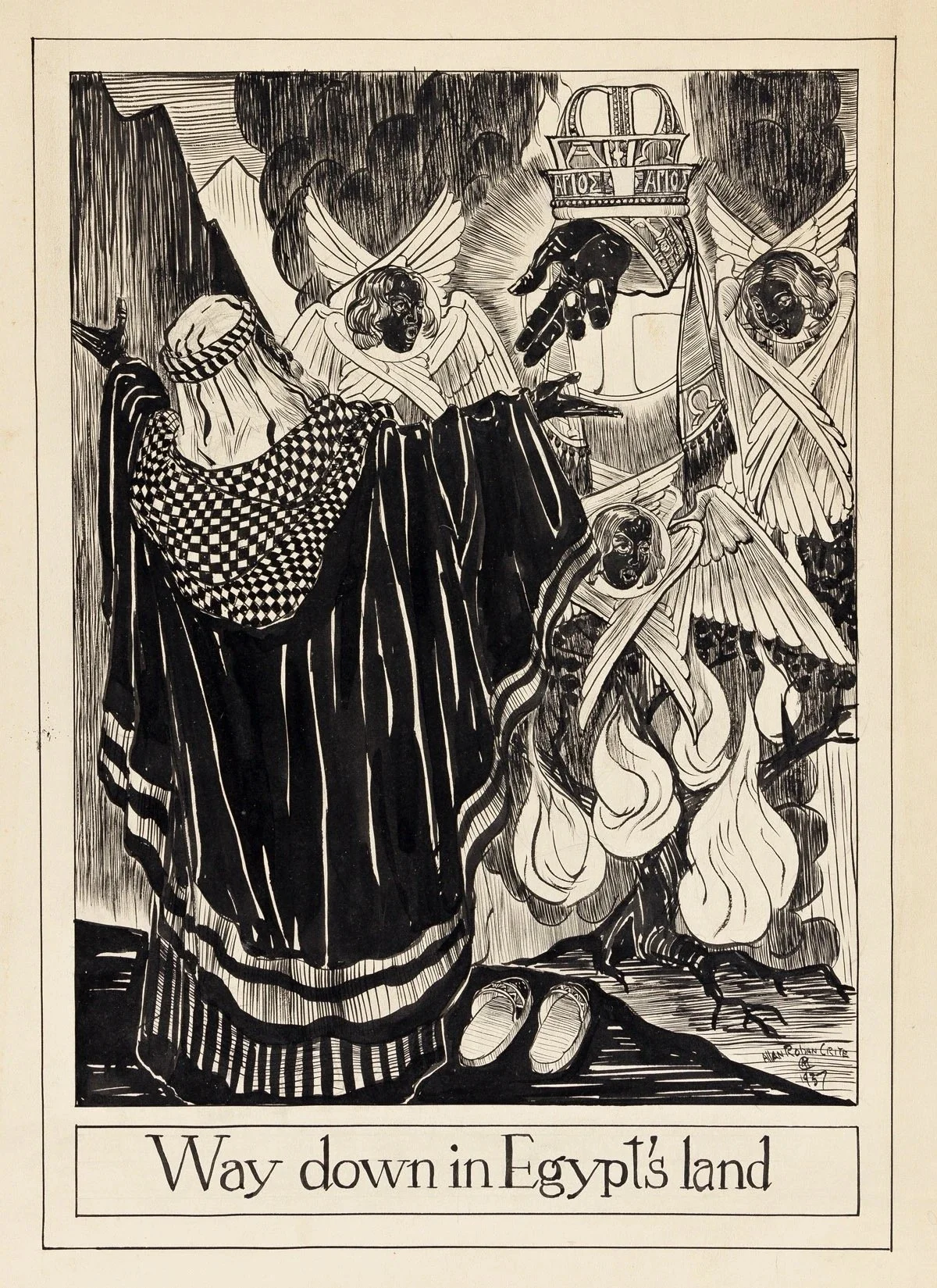
The setting is an open place amid the massive and foreboding peaks of the desert mountains of Egypt.
We can imagine, as the scripture tells us, that Moses has drifted with his flocks ‘beyond the wilderness.’
This isolating, unlikely location is the setting for a miraculous spectacle: a bush is on fire but it is not consumed.
Rising above the white flames and the black twigs of the bush are three seraphs. Their wings become a kind of throne for the massive hand of God emerging from an orb of light.
Above the hand of God is a crown inscribed in Greek with the sacred song: Holy, Holy, Holy.
Although the scripture tells us that Moses, at first, hid his face from God, Crite has shown Moses gazing directly at the great sight.
Moses is overcome with awe, worship, and praise. His arms are thrown open in the ancient gesture of prayer as he speaks with his God.
There is a strange mix of awe and wonder, confidence and intimacy.
Notice, too, that Crite has very shown Moses’ sandals removed from his feet and resting next to him- a sign of the holiness of that place.
Even though we are in a barren wilderness and Moses is a humble shepherd, the place and encounter have become totally sacred. God’s presence and power is not limited by time or place.
And that’s one thing I love about this illustration.
What we might call the nitty-gritty of the human experience—for Moses, a shepherd in the wilderness—collides with the magnificent power of the ageless, transcendent God acclaimed by the heavenly host.
Go down, Moses! We can almost hear the voice speaking to Moses. Humanity is in conversation with God.
And that is a theme we find constantly in the work of the artist, Allan Rohan Crite.
Crite spent most of his career in Boston, and much of his work is on a Christian theme.
He showed the Virgin Mary and Christ child as a Black mother and child on a busy streetcar in the city. He showed Jesus carrying the cross through city streets. He showed saints hovering above churches and schools and hospitals. The divine could be anywhere. The divine IS everywhere, calling us to worship—
like a burning bush in the wilderness, the presence of God was always a meeting of the ordinary and the miraculous.
Crite loved to depict spirituals. For him, the spirituals expressed humanity’s ability to praise and worship God here on earth. The spirituals brought ancient scripture into the singer’s present.
In other words, the spiritual is not just a musical genre. It was also about time,
And the collapse of time.
Crite wrote that the spirituals were ‘oral traditions by which the salient truths and narratives of the Holy Bible were pushed on.’
Go down Moses was, for Crite and so many of his community, about the historical deliverance of God’s people from slavery, but also the present deliverance of Crite’s people
– the friends and neighbors he so frequently depicted –
from racial prejudice:
the spiritual was just as much a hymn about God’s redemption of the Israelites under slavery in Egypt as it was about the yearning for freedom from enslavement and then racial segregation.
But for Crite, the power of the spiritual shows us about God generally.
Go down Moses is about God’s care for his people—Israel—and God’s concern for their liberation. It is a hymn about God’s purpose for us to always be with us and never lead us somewhere without a plan.
We may not know the plan, but when God calls us to God’s freedom, God does not abandon us.
The moment that Crite depicts here at the burning bush, Go down Moses, is really the beginning of the Exodus—the definitive moment in the history of God’s people.
It is the moment when God calls Moses to lead Israel out of Egypt. It is the moment in history of our own life in faith that shows us God’s eternal plan to deliver us from bondage and death.
Crite’s picture, then, is about a moment in the past—a very particular moment, when God’s revelation to Moses at the mountain called Moses to lead his people to freedom from slavery in Egypt. It is a moment of both divine majesty and God’s nature to be close to his people in particular times and places.
The scripture tells us that God observed the misery of his people in Egypt.
God knew their suffering.
But Crite’s picture is also about the present.
When we sing Go down, Moses and see before us the depiction of Moses’ divine encounter, we use our own breath and our own eyes—here and now—to bring that ancient narrative into our present.
And isn’t that a miraculous thing?
You see, the moment of the burning bush is—as Crite shows us—magnificent, awesome, and holy.
But the heart of the story is not the miraculous bush or God’s splendid distance.
The heart of the story is God’s closeness to his people.
It is the summoning of a human being—Moses—into the workings of God’s plan to deliver his people from death to life.
Remember, when Moses asks God what his name is he says not only ‘I AM WHO AM’ but that he is the God ‘of your ancestors, the God of Abraham, the God of Isaac, and the God of Jacob.’
In other words, God says, “I am the God of your ancestors, the God of the past; but I am working in the present!”
This is a God of intimacy, of relationship, of presence with his people.
The call, ‘Go down, Moses!’ is the intimacy of a God who calls his people by name to show God’s love and power.
Way down in Egypt’s land, in the wilderness of the desert mountains—there God has made himself known and God has initiated his purpose to deliver his people.
This is what Crite’s picture is all about. It’s about the past and present brought together in the intimacy of singing the spiritual.
The whole experience becomes a kind of metaphor for how God’s ancient workings are still burning in our present.
We are not Moses. We are not the Israelites. And we have not seen a burning bush.
But we do live in a world where the ordinary and the holy meet.
A world where the God of Abraham, Isaac, Jacob, and Moses still speaks.
And that collapse of time is exactly what we experience at church.
We come to this place to hear the ancient stories of God,
to sing of his mighty acts,
to praise him with ancient words,
to pray to him and worship him with our own souls and bodies.
Where we are standing is holy ground.
What makes it holy is that we speak to God and God speaks to us.
The God of liberation who called Moses at the bush is not finished with us.
In his Son, Christ Jesus, he is still calling us out of bondage and death and into life.
The question is not whether we have seen a burning bush.
The divine spectacle is not the point.
The point is the burning intimacy of the God who sees us and knows us.
And that is why we can still sing, Go down, Moses.
Amen.
